
The One Who Throws Forgets
- El Brown
- May 4
- 8 min read
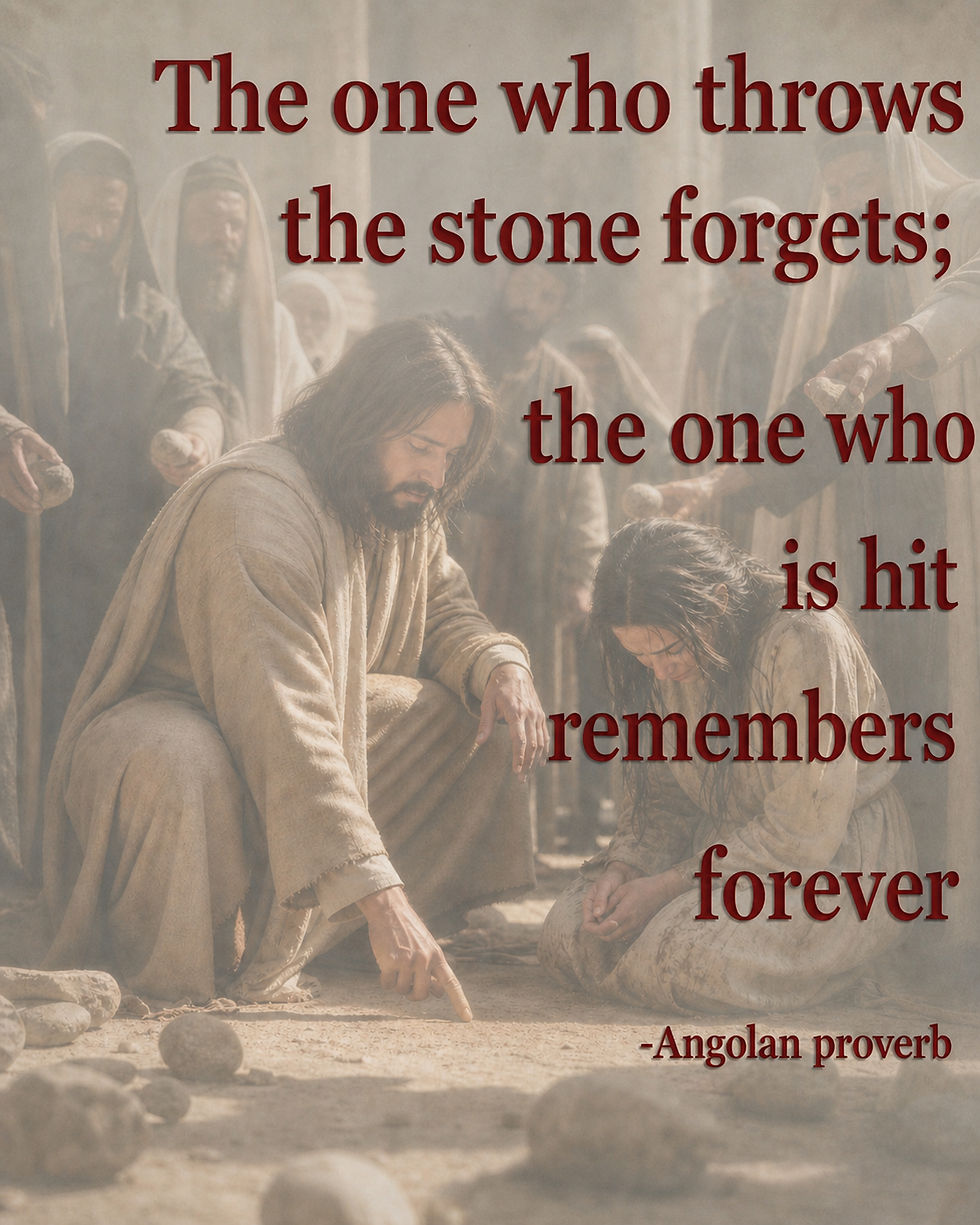
The One Who Throws Forgets
The One Who Is Hit Remembers
A dear friend of mine—someone I fellowship with, someone who reads my devotionals faithfully, someone who carries a steady, strengthening faith—sent me something this morning that seized me the instant I read it.
It was a proverb in a picture. Simple. Short. And somehow… it landed like a thunderclap.
“The one who throws the stone forgets; the one who is hit remembers forever.”
— Angolan proverb
And the first thing that came out of my mouth—before I could even organize a “proper” response—was:
Oof. Boy is this true.
Because it can preach on so many levels.
And those who know me—those who walk with me in this daily place of listening and writing—know this about me: when something hits my spirit like that, I stop. I sit with it. I let the Holy Spirit lift the veil. Because I know He’s not just speaking to me.
He’s speaking through it.
And this proverb… hits—pun not intended—on more levels than we usually want to admit.
Because yes, on one level, it’s obvious:
If you’re the one who gets hit by the stone… you’re always going to remember the hit.
But the other face of it is what’s sobering.
Because if you’ve been hit before… and you remember what that did to your soul… you are far less likely to be the one who throws.
That’s the refining part.
And if you’ve been hit before and you still throw anyway?
That’s the awakening.
Because then we’re not talking about ignorance.
We’re talking about hardness.
We’re talking about forgetting what mercy felt like… the moment you got the chance to hold power.
And this proverb is not just about people being mean.
It’s about how quickly we can become the very thing that wounded us… if we don’t let God heal what the stone did in us.
⸻
The Stone Is More Than a Stone
A stone is never just a stone in Scripture.
A stone is accusation.
A stone is judgment.
A stone is the false comfort of superiority.
A stone is the illusion that being the thrower makes you safe.
But stones don’t make you safe.
They just make you hard.
And it made me think immediately of the story that has always haunted me in the best way—the story where the religious leaders try to trap Yeshua with a woman.
A woman caught in adultery.
And they come dragging her into the light—not for righteousness—but for spectacle. For control. For a legal setup.
And it’s always been interesting to me because the Old Testament is clear: if two guilty parties are caught, the consequences were never meant to fall on one person while the other disappears into the shadows.
If anything, Deuteronomy gives the nuance: if it happens out in the field and she was forced against her will, she is not treated as guilty. (See Deuteronomy 22:23–27.)
So right there… you can see it.
The twisting.
The selective quoting.
The weaponization of Scripture.
Not to honor God.
To trap Yeshua.
To shame the woman.
To elevate themselves.
And doesn’t the enemy do the same to us?
He doesn’t need to invent lies when he can just twist truth.
He doesn’t need new chains when he can repurpose Scripture into condemnation.
But our Warrior Messiah… does something no one expects.
He doesn’t match their energy.
He doesn’t pick up a stone and throw it back.
He stoops.
He goes low.
He writes in the dirt.
And then He says the sentence that has been echoing through centuries like a sword that only cuts pride:
“Let the one who is without sin among you be the first to throw a stone at her.”
— John 8:7 (AMP)
And one by one… they drop the stones.
Because the presence of perfect holiness does not need to shout.
It just needs to stand there.
And the stones fall.
⸻
The Ones Who Remember… Rarely Throw
This is where the proverb becomes a mirror.
Because the one who throws the stone forgets.
Why?
Because throwing doesn’t leave a bruise on their skin.
It leaves a bruise on the soul of the one it hits.
Throwing can feel like power.
But it’s borrowed power.
It’s counterfeit authority.
It’s a momentary rush that comes from feeling “above” someone else.
And then it fades.
So the thrower moves on.
But the one who was hit?
They don’t move on so easily.
Because stones don’t just bruise bodies.
They bruise trust.
They bruise safety.
They bruise identity.
And some people have been hit so many times that they learned to live braced.
Smiling.
Functioning.
Still bleeding.
And here’s what the Holy Spirit began to whisper as I sat with it:
Sometimes the deepest proof that you’ve been healed… is not that you stopped crying.
It’s that you stopped throwing.
⸻
Grace That Was Received… But Not Remembered
And then my mind went to another moment with Yeshua—when He speaks about a woman whose love shocks everyone in the room.
She’s weeping.
Pouring out costly perfume.
Wiping His feet with her hair.
And the religious eyes in the room can’t see love.
They only see her past.
But Yeshua sees the whole story.
And He says:
“For this reason I say to you, her sins, which are many, have been forgiven, because she loved much; but he who is forgiven little, loves little.”
— Luke 7:47 (NASB/AMP sense)
That line is not about God measuring forgiveness in teaspoons.
It’s about awareness.
About memory.
About what a person knows they’ve been spared from.
Because those who remember what mercy cost… love differently.
They carry tenderness differently.
They don’t weaponize their righteousness.
They don’t forget what the stone felt like.
But when someone has received grace… and forgotten… they can become dangerously comfortable with stones.
And I’ve seen it.
We’ve all seen it.
People who have been forgiven much—people who have been rescued, spared, covered, restored—and yet the moment they have the slightest sense of power, they hurl stones with stunning amnesia.
Completely forgetting the pit they came out of.
Completely forgetting the mercy that held them up.
Completely forgetting the patience God extended to them while they were still learning how to walk.
Which brings us to another sobering scripture—because the Word does not let us keep a double standard:
“For just as you judge others, you will be judged; and by the measure you use, it will be measured to you.”
— Matthew 7:2 (AMP)
In other words:
If you love stones… you are choosing the stone-measure.
If you throw stones… you are inviting the same scale.
If you refuse mercy… you are refusing the very atmosphere you need to survive.
⸻
This Proverb Is Comforting… in a Way You Don’t Expect
Because on the surface, this proverb feels like confrontation.
It is.
But there’s another layer that is quietly comforting when you lean into it.
Because it tells the truth about your experience.
It validates what you’ve carried.
It reminds you that what hurt you wasn’t “nothing.”
That you weren’t “too sensitive.”
That the bruise you remember is real because stones have weight.
And the Lord sees the ones who were hit.
He sees the quiet flinches.
He sees the guardedness that formed after repeated impact.
He sees the internal scar tissue.
And He doesn’t shame you for remembering.
He invites you into healing.
Not so you forget what happened…
But so you stop living under its authority.
And so you don’t become a thrower.
Because the love of God for you is not just that He forgives you when you’ve thrown stones.
It’s also that He heals you where you’ve been hit.
So you can live free.
Soft.
Clear.
Whole.
⸻
Final Thought — Drop the Stone, Remember the Mercy
This proverb is a holy interruption.
It asks a question none of us can avoid forever:
Am I throwing stones because I forgot what it felt like to be hit?
Or am I refusing to throw because I remember mercy?
And maybe that’s the deepest invitation hidden inside it:
Don’t just remember your pain.
Remember your rescue.
Remember the hands that could have condemned you… and chose to lift you.
Remember the moments God could have exposed you… and instead covered you until you were strong enough to be healed.
Remember the patience.
Remember the gentleness.
Remember the love.
Because the one who throws forgets…
But the one who is hit remembers.
And when your remembering is healed by Yeshua, it becomes more than memory.
It becomes wisdom.
It becomes restraint.
It becomes tenderness.
It becomes likeness.
And that is another dimension of His love:
He doesn’t just save you from your sin.
He saves you from becoming the kind of person who makes stones feel normal.
So today, if you’re holding one—drop it.
And if you’re still hurting from one—bring it to Him.
Because the One who stooped into the dirt is still the One who stands between you and the stones.
And He is still saying:
Neither do I condemn you.
Now go… and live free.
———
I Hear the Spirit Say:
“Beloved… I am not only watching what is done to you.
I am watching what is forming in you because of what was done.
And this is where I love you fiercely.
Because I refuse to let pain turn into permission.
I refuse to let wounds become weapons.
I refuse to let you inherit the very hardness that tried to destroy your softness.
There are stones you remember because they marked you.
But I am not asking you to carry the mark as your identity.
I am asking you to bring it to Me as evidence—so I can heal it, redeem it, and remove its authority.
Do not make a home in the impact.
Do not build a theology out of the bruise.
Do not let the enemy convince you that remembering means you must remain wounded.
I am the God who restores what was struck.
I am the God who gives tenderness back without making you naïve.
And yes—there are moments when I will put your hand over the stone you were about to throw… and you will feel the weight of it before it leaves you.
Not to shame you.
To wake you.
Because you cannot heal what you keep justifying.
So let Me interrupt you.
Let Me slow you down at the edge of reaction.
Let Me remind you: mercy is not weakness—it is My strength moving through you.
You do not need stones to be safe.
You need My presence.
You do not need accusation to feel powerful.
You need My authority.
And I will teach you the difference.
I will teach you how to be discerning without being cruel.
How to be truthful without being violent.
How to set boundaries without becoming a thrower.
Because some of the greatest victory in your life will not be what you confront…
It will be what you refuse to become.
So drop what is not yours.
Release what does not belong in your hands.
And come closer to Me until your heart remembers this:
I defended you when you were exposed.
I covered you when you were vulnerable.
I spared you when you deserved the stone.
So do not despise the mercy that rescued you.
Let it remake you.
And you will become the kind of person who carries fire in your spirit…
but keeps gentleness in your hands.
Because I did not save you to harden you.
I saved you to make you like Me.”


Comments