
The Place Where His Tent Was at the Beginning
- El Brown
- 1 day ago
- 7 min read
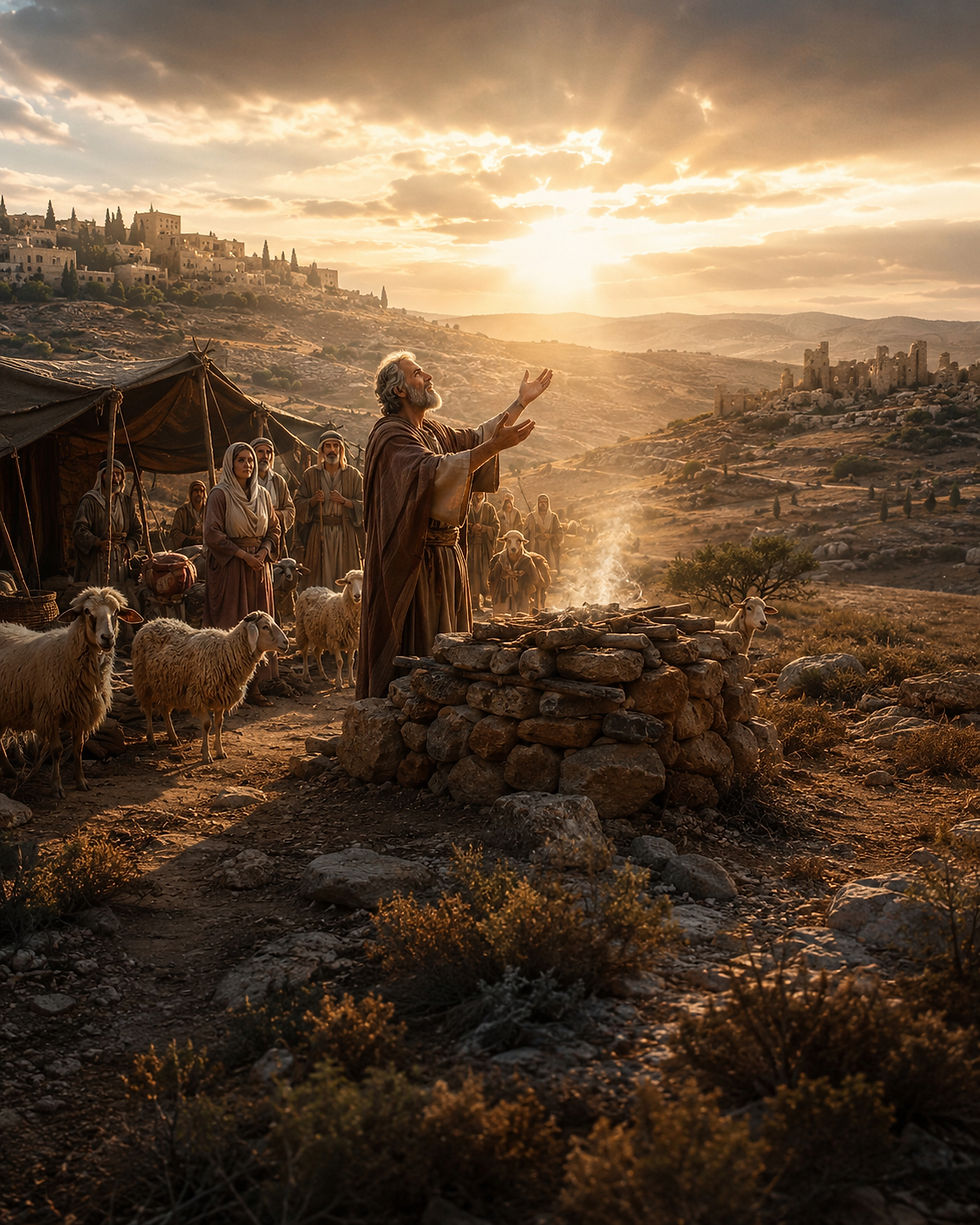
(Genesis 13:3–4 — When Returning Is Not Going Backward, But Coming Back Into Alignment)
There are passages that read so simply you almost move past them without stopping. And then there are moments where a single phrase catches you, not loudly, not dramatically, but with a quiet weight that says, don’t move on yet.
That is what happened to me here.
“He journeyed on from the Negev as far as Bethel, to the place where his tent had been at the beginning…”
— Genesis 13:3 AMP
I couldn’t move past that phrase.
“The place where his tent had been at the beginning.”
Because something in it felt like more than geography. It felt like more than a travel log. It felt like something was being revealed about how God restores alignment—not in theory, but in pattern.
And the more I sat with it, the more it opened.
Because this passage is deceptively simple.
But it is actually a return pattern.
And it reveals something foundational about how alignment is restored after disruption.
⸻
The Context — What Just Happened Before This
Genesis 12–13 is not just a story. It is movement.
God calls Abram.
Abram responds.
Abram journeys.
Abram builds an altar.
There is encounter.
There is alignment.
There is beginning.
And then—famine hits.
Pressure enters.
And Abram goes down to Egypt.
That matters.
Because Egypt, in this moment, represents more than a location. It represents a movement made under pressure. A decision made in response to lack. A step taken outside of the original place of encounter.
And in Egypt, fear enters. Abram misrepresents Sarai. Something shifts internally. There is misalignment.
And yet—God intervenes.
Abram is not abandoned. He is sent out.
So by the time we reach Genesis 13:3–4, this is not just a continuation of a journey.
This is return after misalignment.
⸻
The Original Hebrew — The Movement Beneath the Movement
Genesis 13:3 says:
וַיֵּלֶךְ לְמַסָּעָיו
מִנֶּגֶב וְעַד־בֵּית־אֵל
עַד־הַמָּקוֹם אֲשֶׁר־הָיָה שָׁם אָהֳלֹה בַּתְּחִלָּה
בֵּין בֵּית־אֵל וּבֵין הָעָי
Vayelekh lemasa’av
minnegev ve’ad Beit-El
ad-hamakom asher-hayah sham ohalo battechillah
bein Beit-El uvein ha-Ai
And verse 4:
אֶל־מְקוֹם הַמִּזְבֵּחַ
אֲשֶׁר־עָשָׂה שָׁם בָּרִאשֹׁנָה
וַיִּקְרָא שָׁם אַבְרָם
בְּשֵׁם יְהוָה
El-mekom hamizbe’ach
asher asah sham barishonah
vayiqra sham Avram
beshem YHWH
And when you begin to break this down, you realize:
This is not just telling you where Abram went.
It is showing you how he returned.
⸻
“He Journeyed On” — Not One Step, But Stages
וַיֵּלֶךְ לְמַסָּעָיו — vayelekh lemasa’av
He went. By stages. In journeys. This is not a single movement.
This is intentional retracing.
Step by step. Layer by layer. Returning is not instant. It is progressive.
And that matters. Because sometimes we want immediate restoration. Immediate clarity. Immediate alignment.
But Abram shows us something different. He does not teleport back. He journeys back.
⸻
“From the Negev” — Out of Dryness
מִנֶּגֶב — minnegev
The Negev is the south. A dry place. A wilderness region. A place of lack.
So this is not random direction.
This is movement: out of dryness → back toward encounter
And if we are honest, we all know what the Negev feels like. The place where something feels off.
Where there is dryness. Where decisions were made under pressure. Where something drifted.
Abram does not stay there. He moves out of it.
⸻
“To Bethel” — Back to the House of God
בֵּית־אֵל — Beit-El
House of God.
Now feel the contrast:
Negev → dryness
Bethel → presence
This is not just geography. This is spiritual movement. He is returning to the place of encounter.
⸻
“To the Place Where His Tent Was at the Beginning”
בַּתְּחִלָּה — battechillah
At the beginning. At the first. At the origin point. This is the phrase that held me. Because this is not about location.
This is about alignment.
Abram does not create something new. He does not innovate his way forward. He returns to the place where it started. The place of first encounter. The place of first obedience. The place where his life first aligned with God.
And this is the hidden thread: He returns to where he first met God.
⸻
“Between Bethel and Ai” — The Tension We Live In
Ai — הָעָי — ha-Ai
Means: Heap of ruins.
So now we see something powerful.
Abram’s altar is positioned: Between Bethel (House of God)
and Ai (ruins)
This is not accidental. This is symbolic. Because this is where most of us live. Between presence and pressure. Between clarity and confusion. Between promise and what looks broken.
And right there— in that tension— is where the altar sits.
⸻
“To the Place of the Altar” — The Anchor Point
מְקוֹם הַמִּזְבֵּחַ — mekom hamizbe’ach
The place of the altar.
The altar represents:
Covenant.
Surrender.
Worship.
Alignment.
And notice this:
It says: “which he had made there at the first.”
Again—repetition. Why? Because this is the emphasis.
Return.
Not reinvention.
Return.
⸻
“And There Abram Called on the Name of the Lord”
וַיִּקְרָא… בְּשֵׁם יְהוָה — vayiqra… beshem YHWH
He called out. He proclaimed. He invoked. This is not quiet. This is intentional re-engagement.
Public.
Deliberate.
Restored connection.
He does not just arrive. He re-aligns.
⸻
The Pattern — The Return Cycle
Abram’s pattern:
Called by God.
Builds altar.
Leaves under pressure.
Misaligns.
Returns.
Goes back to the altar.
Calls on God again.
This is not failure. This is formation.
Because alignment is not maintained by never drifting.
It is restored by returning.
⸻
The Larger Pattern Across Scripture
We see this everywhere.
Moses ascends before receiving.
The disciples sit before the Spirit moves.
Yeshua withdraws before choosing the twelve.
And here: Abram returns before continuing.
The pattern is consistent: Disruption.
Drift.
Return.
Realignment.
Continuation.
Not forward at all costs. But forward after alignment.
⸻
The Key — He Did Not Build a New Altar
This is the part we cannot miss. Abram does not build a new altar. He returns to the first one.
Meaning: God did not require reinvention. He required realignment.
And that is freeing.
Because sometimes we think: “I need a new strategy. “I need a new beginning. “I need to fix everything.”
But often, what God is asking is simpler—and deeper:
Return.
Return to the place where you first met Him. Return to the place where your heart was aligned. Return to the place where your identity was anchored.
⸻
What This Means for Us Now
There are moments where: Things drift. Pressure leads us somewhere unexpected. Decisions get made outside alignment.
And the instinct is: Fix it quickly. Move forward anyway. Push through.
But this passage shows us something different.
The power is not in rushing forward.
The power is in returning. Because returning is not regression.
It is restoration.
⸻
The Scroll Within the Scroll
Abram’s journey reveals that after seasons of drift, fear, or misalignment, the path forward is not found in creating something new, but in returning to the original place of encounter, where identity, covenant, and alignment are restored before movement continues.
⸻
Final Thought
He journeyed. From dryness. To presence. Back to the beginning.
To the altar.
And there— he called on the name of the Lord.
And maybe that is the invitation. Not to rush ahead. Not to force clarity. Not to build something new out of pressure.
But to return.
Because returning is not going backward. It is coming back into alignment with what was always true.
And from that place—everything moves forward differently.
———
I Hear the Spirit say:
“You have been taught to think that moving forward is always the answer.
But I am showing you that sometimes the holiest movement is not forward—
it is back to where you first found Me.
Because I never lost the place where we met.
Even if you did. Even if pressure pulled you. Even if fear redirected you. Even if decisions were made in moments that did not fully reflect who you are in Me—
I was still there.
At the beginning. At the altar. At the place where your heart first said yes.
So when I call you to return, I am not asking you to relive your past.
I am inviting you to recover your alignment.
Because what was true then— is still true now.
What I spoke then— still stands.
What I established then— was not undone by where you went after.
And I see how you sometimes think you need to build something new to make up for what feels lost.
A new strategy. A new structure. A new way forward.
But listen carefully: I am not asking you to strive for something new. I am asking you to stand again in what was already established.
Return to the altar. Return to the place where your identity was not shaped by pressure. Return to the place where you knew Me without striving. Return to the place where your yes was simple and your heart was open.
Because that place is not behind you. It is available to you now. And you do not have to rush to get there.
You will journey. Step by step. Layer by layer. And that is not delay.
That is restoration.
So do not despise the process of retracing. Do not rush past the places I am bringing you back through. Because I am not just moving you geographically.
I am restoring you internally.
And yes—you will feel the tension.
Between Bethel and Ai. Between what I have promised and what looks broken. Between presence and pressure.
But that tension is not your failure. It is the place where the altar stands.
And if you will return there— if you will call on Me again, not out of performance, but out of recognition— you will find that I did not move. You will find that I am still speaking. You will find that alignment is not as far as it felt.
And from that place— you will move forward again.
Not carrying the weight of misalignment. Not striving to correct what you think you broke.
But moving from a place that is restored, re-anchored, and re-aligned.
So do not be afraid to return. It is not regression. It is recalibration.
It is not going backward. It is coming back into truth.
And when you stand there again—
you will realize: Nothing was wasted. Everything was leading you back to the place where I could meet you again— and move you forward from wholeness.”


Comments