
Your God
The Heart, the Crossing, and the Center That Must Not Move
“You shall love the LORD your God with all your heart and mind and with all your soul and with all your strength [your entire being].”
— Deuteronomy 6:5 AMP
There are passages in Scripture so familiar that familiarity itself can become a veil. We recognize the words so quickly that we can accidentally outrun the revelation inside them.
That happened when I opened today’s Scripture.
The first thing that caught my attention was you shall.
Then two words I couldn’t quite move past.
Your God.
And as I began writing, something else emerged. Heart and mind. Soul. Strength. Entire being. It was almost as though Moses kept reaching farther into the human person until there was nowhere left untouched.
But before we pull this verse apart, we need to put it back where it belongs.
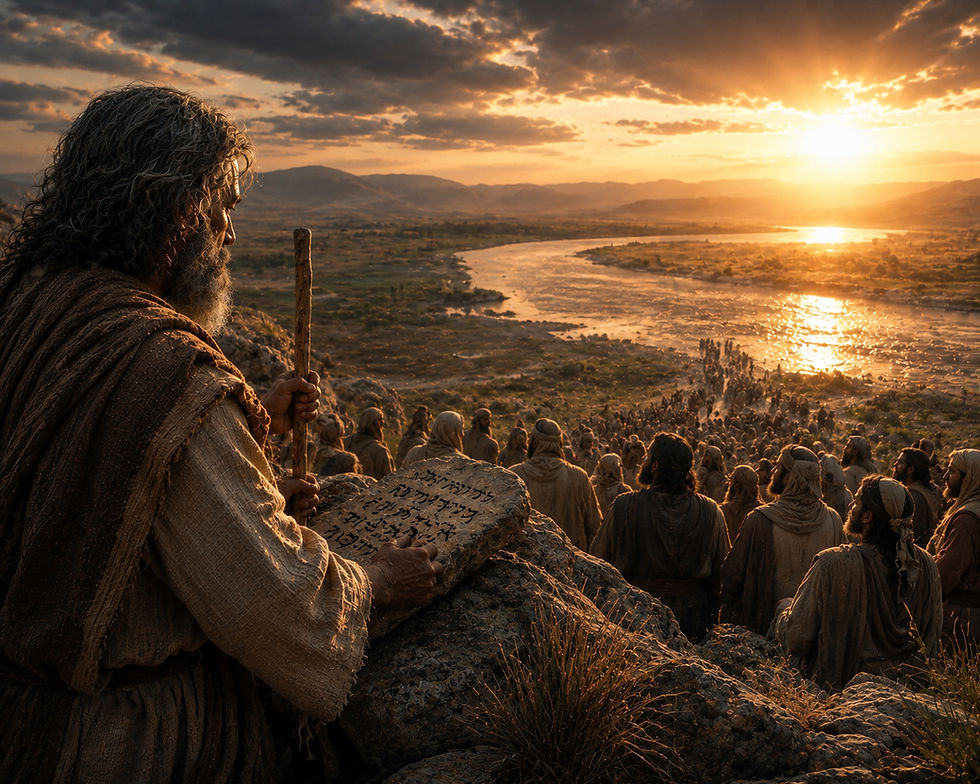
Because Moses is speaking to people standing on the edge of a river.
And once I saw the Jordan behind these words, everything changed.
⸻
Before the Land, the Heart
Imagine standing with Israel east of the Jordan.
Behind them is Egypt. Pharaoh. A sea that opened. Sinai trembling beneath the presence of God. Forty years of wilderness. Manna. Water from rock. Mercy. Rebellion. And graves belonging to a generation that came out but did not go in.
Ahead of them is water again.
And beyond it?
Promise.
They are standing in that extraordinary place between what God has brought them through and what He is about to bring them into.
And Moses knows something they cannot yet fully appreciate.
He will not cross with them.
So these are not casual instructions. These are covenant words being entrusted to a people whose circumstances are about to change dramatically.
In Deuteronomy 6:1, Moses explains that God’s commandments are to be practiced in the land they are going over to possess.
Did you catch that?
God gives them instructions for possession before possession.
And what is the instruction that becomes central?
Love Me.
They are preparing to inherit cities, houses, vineyards, wells, and territory, and God begins talking about their hearts.
I wonder how often we prepare for a new season by asking about strategy, timing, opportunities, and doors, while God is addressing something underneath all of them.
Because what happens when the thing we’ve prayed for finally arrives, but our hearts have not learned how to steward it?
Perhaps before God changes what surrounds us, He wants to establish what governs within us.
⸻
You Shall Love Your God
The Hebrew begins:
וְאָהַבְתָּ — ve’ahavta
And you shall love.
From אָהַב — ahav, meaning to love.
But this is not merely sentimental affection. In this covenant setting, love includes loyalty, devotion, allegiance, and obedience.
We often think of love as something that happens to us. We fall into it. We feel it. We are swept away by it.
Yet God commands love.
Which means biblical love must involve more than emotion.
It involves direction.
Where do our decisions face? Our desires? Our thoughts? Our resources? Our future?
And then come the words that first arrested me.
יְהוָה אֱלֹהֶיךָ — YHWH Elohekha.
The LORD your God.
Not a distant deity whose attention Israel must somehow earn.
Their God.
The One who heard their cries in Egypt, confronted Pharaoh, divided the sea, fed them in the wilderness, and remained faithful through their unfaithfulness.
Moses is not introducing them to God.
He is reminding them Whose they are.
And they are about to enter a land filled with competing gods, competing allegiances, and competing definitions of security and prosperity.
Before those voices begin speaking, Moses establishes their identity.
YHWH is your God.
There is something almost breathtaking about the intimacy of that.
David could say, “The LORD is my shepherd.”
Thomas could stand before the resurrected Yeshua and declare, “My Lord and my God!”
Not merely that God exists.
My God.
And I wonder whether there is a difference between knowing a great deal about God and learning to live with the confidence that we belong to Him.
One is knowledge.
The other is relationship.
⸻
The Word That Claims Everything
Then comes a word Moses repeats three times.
בְּכָל — bekhol.
With all.
All your heart.
All your soul.
All your strength.
The Hebrew gives us three remarkable expressions.
First, לֵבָב — levav, the heart.
But in biblical Hebrew, the heart is not merely the place of emotion. It encompasses thought, understanding, desire, intention, memory, and will.
The heart is the inner center from which decisions take shape.
And suddenly Proverbs 4:23 becomes even more meaningful. We are told to guard our hearts because the springs of life flow from them.
Yeshua likewise teaches in Matthew 12:34 that the mouth speaks from what fills the heart.
Do you see the direction?
From the invisible to the visible.
From the interior to the outward life.
So when God says, Love Me with all your heart, I hear something profoundly intimate.
Give Me the source.
The place where fear whispers. Where imagination begins building futures. Where resentment can take root or forgiveness can begin. Where a decision becomes direction before our feet ever move.
And modern science offers an interesting parallel. The physical heart and brain continually exchange information through the nervous system, reminding us that our embodied lives are deeply interconnected. That is not what the Hebrew word levav scientifically describes, but it gives us another reason to marvel at how integrated we are.
God is not asking for a little affection tucked into one compartment of our lives.
He is calling for the center.
Then comes נֶפֶשׁ — nephesh.
Often translated soul, but its meaning can include life, person, self, appetite, and living being.
Genesis 2:7 says humanity became a living nephesh when God breathed life into the dust.
So loving God with all our nephesh reaches into our actual, embodied existence.
The person driving the car, answering the email, lying awake at night, facing disappointment, choosing words, managing resources, and navigating relationships.
Our ordinary lives become part of our response.
And then comes my favorite.
מְאֹד — me’od.
Usually an adverb meaning very, exceedingly, or much.
In Genesis 1:31, God calls His creation tov me’od—very good.
But here, that word of intensity becomes part of what we offer.
With all your me’od.
With all your capacity. Your strength. Your resources. Everything you can bring to bear.
I love thinking of it as:
With all your muchness.
Heart. Life. Muchness.
The inner center. The living self. Everything available to us.
What remains outside the command?
Nothing.
And perhaps that is precisely the point.
⸻
What Possesses the Heart?
Now put those words back beside the Jordan.
Israel is preparing to possess land.
But what if something else possesses their hearts?
They can inherit houses while abundance begins governing them. They can receive vineyards while appetite becomes their master. They can occupy territory while fear still determines their decisions.
We can possess the blessing and still be possessed.
And suddenly I understand why Moses speaks about love before they cross.
Because whatever possesses our hearts will influence how we handle whatever comes into our hands.
Then comes the warning in Deuteronomy 6:10–12.
Moses tells them they will enter cities they did not build, houses filled with things they did not provide, and vineyards they did not plant.
They will eat and be satisfied.
And then he warns them not to forget the LORD who brought them out of Egypt.
Think about that.
We often assume the wilderness is the spiritually dangerous place.
But Moses warns them about prosperity.
In the wilderness, manna was miraculous because there was nothing else to eat. In Canaan, they would have fields.
In the wilderness, water was miraculous because it came from impossible places. In Canaan, they would have wells.
What happens when the thing we once prayed for becomes so familiar that we forget the One who answered?
When provision becomes ordinary furniture?
When the answered prayer no longer reminds us of the nights we cried out for it?
The danger is not only that suffering can make us question God.
Blessing can make us forget Him.
And now the command becomes even more extraordinary.
Before the house. Before the vineyard. Before abundance.
Love the LORD your God.
Because the goal was never merely Canaan.
The goal was covenant.
The land was inheritance.
But God Himself was the treasure within it.
⸻
Training the Heart to Return
Immediately after commanding Israel to love Him, Moses says in Deuteronomy 6:6–7 that His words are to be upon their hearts and taught diligently to their children.
They are to speak of them when sitting at home, walking along the road, lying down, and rising.
Notice the pattern.
Love Him with the heart.
Place His words upon the heart.
Then rehearse them throughout ordinary life.
Morning. Evening. Movement. Stillness.
Again and again.
And I find this fascinating because modern neuroscience recognizes that repeated attention and behavior can help strengthen patterns of thought and response through neuroplasticity.
Moses was not teaching neuroscience.
He was teaching covenant formation.
But the connection invites a wonderful question.
What if remembering God is something we can become increasingly practiced at doing?
Perhaps loving Him with all our hearts does not mean we never experience fear.
It means fear does not have to retain control of the center.
Maybe yesterday our first response was panic, but today there is a moment of recognition before we follow it.
A pause.
And in that pause, we remember Whose we are.
That is not perfection.
That is formation.
We become distracted.
We return.
We become afraid.
We return.
We begin trusting an outcome more than the One who promised to lead us.
We return.
Like a compass finding north after being shaken, love learns where to turn.
And the more familiar His voice becomes, the more readily we can find our way back.
⸻
The Center That Does Not Move
Centuries later, someone asks Yeshua which commandment is greatest.
And in Matthew 22:37, He reaches back to Deuteronomy.
Love the Lord your God with all your heart, soul, and mind.
Then He adds the command to love our neighbors as ourselves.
And He declares that the Law and the Prophets depend upon these commandments.
Imagine asking Yeshua to identify the load-bearing beam beneath the enormous architecture of Scripture.
He points to love.
Not merely the emotion.
The orientation of an entire life toward God, expressed in love toward others.
And now I find myself returning to Israel standing beside the Jordan.
Because crossover changes geography.
It changes circumstances.
Sometimes it changes responsibilities, relationships, resources, and everything familiar.
But direction requires a reference point.
We can move quickly without moving wisely. We can experience increase without experiencing peace. We can enter new territory without knowing who we are once we arrive.
And perhaps that is why God begins here.
Not with the land.
With the center.
I have been thinking about the seasons when Holy Spirit seems to keep returning us to the same instruction.
Stewardship. Discernment. Humility. Boundaries. Rest. Love.
We may be asking what is coming next, while He is teaching us how to live faithfully regardless of what comes next.
Because the deepest question may not be, What am I about to enter?
But rather:
Who will be at the center when the answer is finally in my hands?
⸻
Your God
I began this morning noticing two simple words.
You shall.
Then:
Your God.
But once I placed them beside the Jordan, something extraordinary became visible.
God was preparing Israel for outward expansion by establishing inward allegiance.
Before the land, the heart.
Before possession, love.
Before abundance, remembrance.
And now I wonder whether some of the most important preparation in our own lives happens long before anything outwardly changes.
In the quiet decisions. The repeated returns. The moments when we choose to remember what is true instead of surrendering to whatever feels most urgent.
Because we can receive something extraordinary and still lose sight of the One who gave it.
Or we can enter the new landscape carrying the intimacy we learned in the wilderness.
Perhaps that is the wonder of Deuteronomy 6:5.
God does not merely want to accompany us into the places He leads us.
He invites us to love Him with the entirety of who we are, so that wherever we go, we remain rooted in Whose we are.
And when the doors open, when the prayers are answered, when the scenery changes and what once seemed impossible becomes our everyday life, may we still recognize the One who brought us there.
Not merely as the God who gave us something.
But as our God.
Because perhaps the greatest miracle of crossing over is not simply arriving in the land.
It is becoming people who can hold what God gives without allowing it to take His place.
People who can stand surrounded by answered prayers and still know where home is.
And when every part of us is invited to respond—heart, soul, strength, and all our me’od—may our answer remain beautifully, unmistakably simple.
You are my God.
And all of me is Yours.
———-
I Hear the Spirit Say…
“Beloved, I know how long you have waited. I know the prayers you have whispered when no one else was listening, the tears you have wiped away before anyone could see, and the moments when you wondered whether you had somehow misunderstood what I promised.
But My child, I have never confused your waiting with your readiness, nor have I mistaken your weariness for a lack of faith.
I have seen every time you chose to trust Me when you had no visible reason to believe anything was changing. Every time you surrendered the outcome only to find yourself reaching for it again. Every time you came back to Me with trembling hands and an honest heart.
And I have treasured every return.
You have spent so much time wondering when your circumstances would finally change that you have not always recognized how much you have changed within them.
There are things that once would have undone you that no longer have the same authority over your heart. There are voices you once believed that you are beginning to recognize as strangers. There are burdens you once carried as though they belonged to you that you are finally learning to place in My hands.
And beloved, I see that.
I see the tenderness you have preserved when life gave you reasons to become hardened. I see the courage it has taken to remain open when closing yourself off would have felt safer.
So do not measure My faithfulness only by what has arrived.
Look at what has been restored within you.
You are not entering what comes next as the same person who first began praying for it.
And when the things you have waited for begin to unfold, you will discover that you do not have to cling to them in fear. You can receive them with open hands because your security was never meant to rest in what you hold.
It rests in Me.
Beloved, that is how you will know the crossing is complete. Not merely because your feet are in new territory. Because your whole being still knows exactly Whose you are.”


Comments