
The Other Half of Circulation
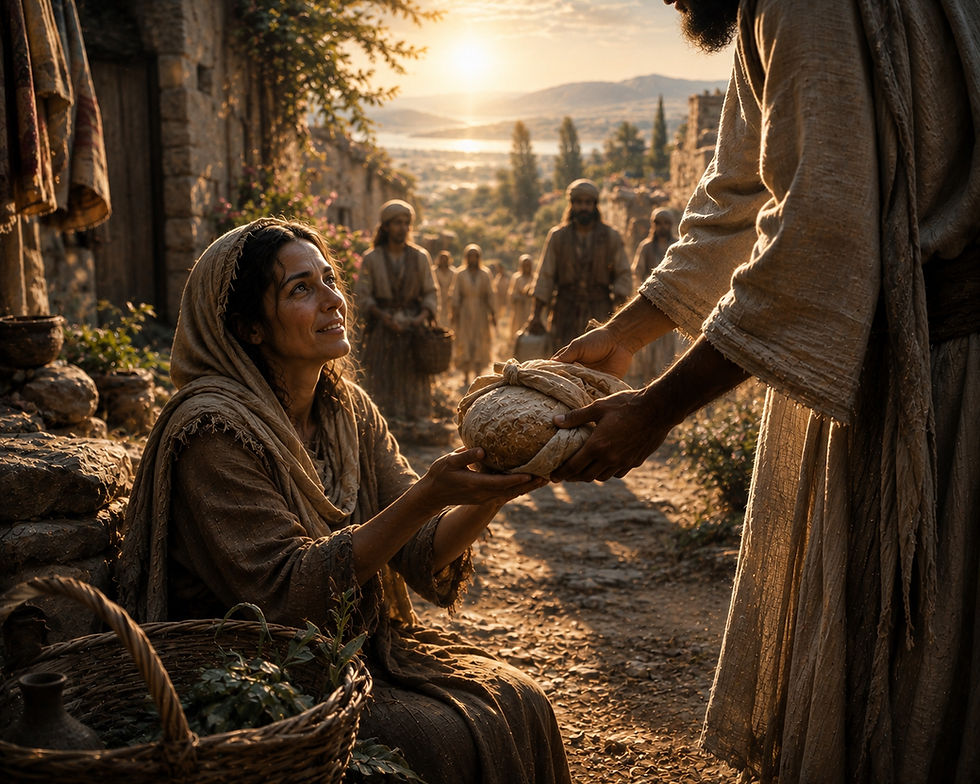
THE OTHER HALF OF CIRCULATION
The Open Hand, the Vulnerability of Receiving, and the Love That Flows Both Ways
I was reading a devotional when it quoted something Paul said Yeshua had taught:
“It is more blessed to give than to receive.” — Acts 20:35
I have heard those words countless times. I know them. I believe them. And as someone whose natural posture is to give, they have always made sense to me.
Giving comes easily.
Receiving does not.
And as I sat with those words, I began reflecting on seasons when God has been very specifically teaching me how to receive. Even now, I am still learning.
But something about this familiar passage caught my attention.
Why is it that we can so readily give love, encouragement, time, help, and resources to someone else, yet become strangely uncomfortable when those same things are extended toward us?
Why can it feel easier to carry someone else’s burden than to allow someone to carry ours?
And what if receiving is not merely something we need to become better at?
What if it is an entirely different kind of spiritual formation?
I began to wonder whether there comes a point when God says, in effect:
You have learned how to let My love move through you. Now I am teaching you how to let My love reach you.
Those are not the same lesson.
And the more I followed that thought, the more I began to see something I had never quite recognized before.
⸻
More Blessed Does Not Mean Receiving Is Less Holy
Paul records Yeshua’s words in Acts 20:35:
“In everything I showed you [by example] that by working hard in this way you must help the weak and remember the words of the Lord Jesus, that He Himself said, ‘It is more blessed [and brings greater joy] to give than to receive.’” — AMP
Something interesting appears immediately.
Those exact words of Yeshua are not recorded in the four canonical Gospels. Paul is preserving a saying of Yeshua that had been remembered and passed down among His followers.
The Greek reads:
μακάριόν ἐστιν μᾶλλον διδόναι ἢ λαμβάνειν
Makarion estin mallon didonai ē lambanein.
It is more blessed to give than to receive.
Two words caught my attention.
διδόναι — didonai: To give, grant, or bestow.
λαμβάνειν — lambanein: To receive, take, or accept.
And lambanō, the verb from which lambanein comes, can also describe taking hold of something.
That made me think.
Receiving is not always an entirely passive experience.
Someone extends something toward us, but we must still be willing to accept what is offered.
There can be vulnerability in receiving.
There can be trust.
There can even be faith.
But here is where the passage becomes especially interesting.
Yeshua says giving is more blessed.
He does not say receiving is wrong.
And if receiving were somehow spiritually inferior, wouldn’t that create an extraordinary contradiction within the gospel itself?
“For God so loved the world, that He gave His only begotten Son…” — John 3:16
God gives.
And what must we do?
Receive.
John 1:12 tells us that those who received Him were given the right to become children of God.
And there is lambanō again.
We cannot earn grace, manufacture mercy, or repay the Cross.
There are places in the Kingdom where receiving is not merely permitted.
It is the only possible posture.
And suddenly, receiving begins to look very different.
⸻
When Giving Feels Safer Than Receiving
I think there is something particularly confronting about this for those of us who naturally give.
Because giving feels powerful.
Receiving feels vulnerable.
When I give, I determine what I give, how much I give, and when I give it.
But when someone extends something toward me, I am no longer directing the exchange.
I must allow myself to be on the receiving end of someone else’s generosity.
And sometimes that exposes things giving never touches.
Have you ever noticed how quickly we can accept responsibility for someone else’s needs, yet feel strangely exposed when someone notices our own?
Perhaps we have become comfortable being the encourager, the helper, the one who shows up, the one who knows what to do.
And underneath completely genuine generosity, there may be beliefs we never realized were there.
I don’t want to burden anyone.
I would rather do it myself.
I don’t want to owe anybody anything.
I know how to be needed. I’m not quite sure how to need.
None of that necessarily means our giving has been unhealthy.
But what if the very thing we have called independence has quietly prevented us from experiencing a particular expression of God’s love?
And what if God uses receiving to ask us a question that giving never could?
Can you be loved when you haven’t done anything to earn the moment?
Sit with that for a moment.
Because there is a difference between knowing we are loved and allowing ourselves to experience love without immediately trying to deserve it.
And that brings me to Peter.
⸻
Sometimes Surrender Looks Like Letting Someone Else Kneel
In John 13, Yeshua kneels to wash His disciples’ feet.
When He comes to Peter, Peter protests:
“You shall never wash my feet!” — John 13:8
Now think about what Peter is refusing.
Not correction.
Not suffering.
Service.
His Lord is offering to do something for him, and Peter cannot bring himself to receive it.
On the surface, his response almost sounds honorable.
You shouldn’t be serving me.
But Yeshua answers:
“If I do not wash you, you have no part with Me.” — John 13:8
Isn’t that extraordinary?
Peter’s resistance to receiving is interfering with something Yeshua wants to accomplish.
And suddenly I found myself wondering how often we do something similar.
We are willing to serve Him.
Willing to sacrifice.
Willing to pour ourselves out.
But when He approaches us with something we cannot produce for ourselves, do we instinctively pull back?
Sometimes surrender looks like letting someone else kneel.
Sometimes holiness is not, Let me serve.
Sometimes holiness says, Sit still and let Me wash you.
And what makes this even more fascinating is that Yeshua Himself demonstrates the other side of the exchange.
In Mark 14, a woman pours extraordinarily expensive perfume upon Him.
Others object. They begin calculating what else could have been done with it.
But Yeshua does not refuse her extravagance.
He receives it.
And He defends her.
“She has done a beautiful thing to Me.” — Mark 14:6
The One who would give more than anyone who has ever lived allowed Himself to receive extravagant love.
He allowed her gift to have meaning.
And that opened another thought.
Receiving well can honor the giver.
Because if someone gives from a genuine place of love, and I continually refuse what they extend simply because receiving makes me uncomfortable, I may be preventing them from experiencing the very blessing of giving that Yeshua described.
After all, someone has to receive for someone else to give.
And that is when the picture became much larger.
⸻
The Other Half of Circulation
Paul describes the Body of Christ as interdependent.
In 1 Corinthians 12:21, he says the eye cannot tell the hand, “I have no need of you,” nor the head say the same to the feet.
And I wonder whether that statement quietly confronts the natural giver.
What if we have become so comfortable being needed that we have convinced ourselves we should not need anyone?
But God never designed His Body to function through isolated self-sufficiency.
He distributes gifts among different people.
He places something in my hands that someone else needs.
And then He places something I need in someone else’s hands.
Now both of us must participate.
And suddenly I began thinking about the physical heart.
The heart pumps blood outward, circulating oxygen and nutrients throughout the body.
But that is only half of its function.
Blood must also return to the heart.
The heart receives that returning blood, fills, and pumps again.
Imagine a heart that only emptied and never filled.
We would not call that an extraordinarily generous heart.
It would eventually be unable to function.
The filling makes the next outflow possible.
And there it was.
Receiving is not the opposite of generosity.
Receiving is part of the circulation that allows generosity to continue.
Then I thought about breathing.
Inhale.
Exhale.
Receive.
Give.
I do not apologize for taking a breath. I do not consider myself selfish because my lungs require oxygen.
I instinctively understand that if I intend to breathe out again, I must first receive another breath.
So why do we sometimes approach our spiritual and relational lives as though perpetual outflow were the highest form of faithfulness?
Perhaps some of us have been trying to exhale for years while wondering why we are exhausted.
And once I saw that pattern, I began noticing it throughout Scripture.
A branch receives from the vine before it bears fruit (John 15:4–5).
The disciples are told they will receive power when Holy Spirit comes upon them, and then they will become witnesses (Acts 1:8).
And Yeshua Himself lived in continual communion with the Father.
“The Son can do nothing of Himself, unless it is something He sees the Father doing.” — John 5:19
His giving flowed from that relationship.
What if receiving is not merely how we recover after giving?
What if receiving is part of how God designed fruitfulness to begin?
⸻
The Grace of Being Given To
I think this is where receiving becomes especially personal.
Because giving can sometimes allow us to maintain an unspoken equation.
I contribute, therefore I belong.
I am useful, therefore I am valuable.
But receiving something we have not earned confronts that equation.
Grace has always confronted it.
Grace tells us that love is not something we must continually produce enough goodness to deserve.
And perhaps learning to receive is one of the ways God brings that truth out of our theology and into our actual experience.
Can someone love me without my immediately trying to repay them?
Can someone carry me for a moment without my feeling ashamed that I am not carrying them?
Can I receive something simply because someone delighted in giving it?
That last question reaches somewhere deep.
Because sometimes we are not struggling to believe that God is generous.
We are struggling to believe we can be the recipients of generosity without becoming indebted to it.
And there is trust hidden inside all of this.
Giving says:
I trust God enough to release what is in my hand.
Receiving says:
I trust God enough to open my hand.
Both require surrender.
One releases possession.
The other may require surrendering control.
And sometimes the second surrender is harder.
Now, learning to receive does not mean accepting everything from everyone.
Discernment still matters. We can recognize when generosity comes with unhealthy expectations or when accepting something would compromise a necessary boundary.
But I also wonder how often we confuse discernment with reflexive refusal.
Someone offers to help, and before we have even considered it, we respond:
No, I’m fine.
What if that response is not always discernment?
What if sometimes it is simply a reflex we have practiced for so long that it feels like wisdom?
And perhaps the next time something genuinely good is extended toward us, Holy Spirit may invite us to pause long enough to consider a different response.
Thank you. I receive that.
Five simple words.
And yet, depending on what receiving has represented in our lives, those five words may require more surrender than we realize.
⸻
The Open Hand
And then I saw something that brought the entire passage together.
If Yeshua says it is more blessed to give than to receive, then allowing someone else to give to me can become an expression of love toward them.
Because I am allowing them to occupy the blessed position of giver.
Sometimes receiving is generosity from the other side.
Isn’t that a beautiful thought?
And perhaps this is why God leads us through different seasons.
There are seasons when He teaches us to release.
And there are seasons when He teaches us to receive.
But notice what remains the same.
The hand is open in both.
There is the revelation.
The opposite of generosity is not receiving.
Perhaps the deeper opposite of Kingdom generosity is a clenched hand.
A closed hand cannot give.
But it cannot receive either.
And I wonder whether spiritual maturity has less to do with always occupying the role of giver and more to do with remaining responsive to the One directing the flow.
If He says give, give.
If He says receive, receive.
If He says release, release.
If He says rest, rest.
Because the direction may change, but the Source does not.
And perhaps that is what Holy Spirit has been teaching me through this entire reflection.
I have spent so much of my life learning how to recognize the needs of others, how to extend love, how to show up, how to pour.
But there is another kind of attentiveness He is cultivating.
Can I recognize His goodness when it is moving toward me rather than through me?
Can I allow someone else the joy of being His hands?
Can I receive without immediately converting the gift into an obligation?
Can I let love reach me?
I think about the branch receiving from the vine, the heart filling before it pumps again, the lungs taking in another breath.
None of them apologize for the way they were designed.
And perhaps we were never meant to apologize for needing what God has chosen to provide through one another.
Maybe receiving was never the interruption of giving I thought it was.
Maybe it was always part of the same holy circulation.
One hand opens to release.
Another opens to receive.
And eventually the direction changes again.
The gift moves.
Love moves.
Provision moves.
The Body moves.
And God remains the Source of all of it.
So perhaps sometimes the holiest thing a natural giver can do is stop reaching for what they can give next, open both hands, and whisper:
“Father, help me to receive what You have been trying to give me.”
⸻
I Hear the Spirit Say…
“Beloved, there are ways I desire to answer you that require you to stop deciding beforehand what My answer should look like.
You have watched for Me in the miraculous, but do not overlook Me in the ordinary. Do not become so accustomed to looking toward heaven that you miss what I have already placed beside you.
I am still the One who sends ravens. I am still the One who provides in unexpected places. And I am still the One who knows how to reach you through people, circumstances, and expressions of kindness you never anticipated.
Do not reject the gift because you do not recognize the wrapping.
There are prayers you have prayed that I am answering through vessels you would not have chosen and pathways you could not have predicted.
You asked Me for My hand, beloved. Do not insist that My hand must always arrive looking like Mine.
Sometimes My hand will look like theirs.
And there is something I am restoring within you that goes deeper than provision.
I am teaching you that not every kindness conceals an invoice. Not every tenderness carries a hidden condition. Not everything placed into your hands will eventually be demanded back.
Some things are simply gifts.
Let them be gifts.
You have learned to search for the lesson inside difficulty. Now learn to recognize My goodness inside delight.
There are places within you that will not be healed by another battle. They will be healed as you discover that you can experience joy without continually preparing for its disappearance.
So do not brace when I bless you.
Discern, yes. Listen, always. But remember, beloved, discernment is not suspicion.
There will be moments when My love reaches you through something as simple as another person saying, “Here, this is for you.”
And I want you to recognize Me there too.
I am enlarging your capacity, not merely to carry responsibility, but to receive goodness. There are blessings that require room. There is love that requires room. There is joy that requires room.
And sometimes I enlarge the vessel not because what is coming is heavy, but because what is coming is abundant.
So when kindness finds you, do not immediately search for what you owe.
Look at Me.
When provision appears somewhere you were not looking, do not dismiss it because it arrived differently than you prayed.
Look at Me.
You will begin recognizing that My fingerprints have been in places you never thought to look.
And one day you may look around at the people, the tenderness, the unexpected doors, the inexplicable peace, and realize I was answering you before you knew how to recognize the answer.
Beloved, I am not merely teaching you another posture.
I am teaching you another way to recognize Me.
So leave room for surprise.
I know what delights you. I know what restores you. I know what you need before language ever reaches your lips.
And I know how to find you.
You have spent so much time asking, “Father, how can I be Your hands today?”
Now listen carefully when I whisper:
“Beloved, look around. Whose hands am I using to reach you?””



Comments