
The Witness
- El Brown
- 5 hours ago
- 15 min read
Scripture
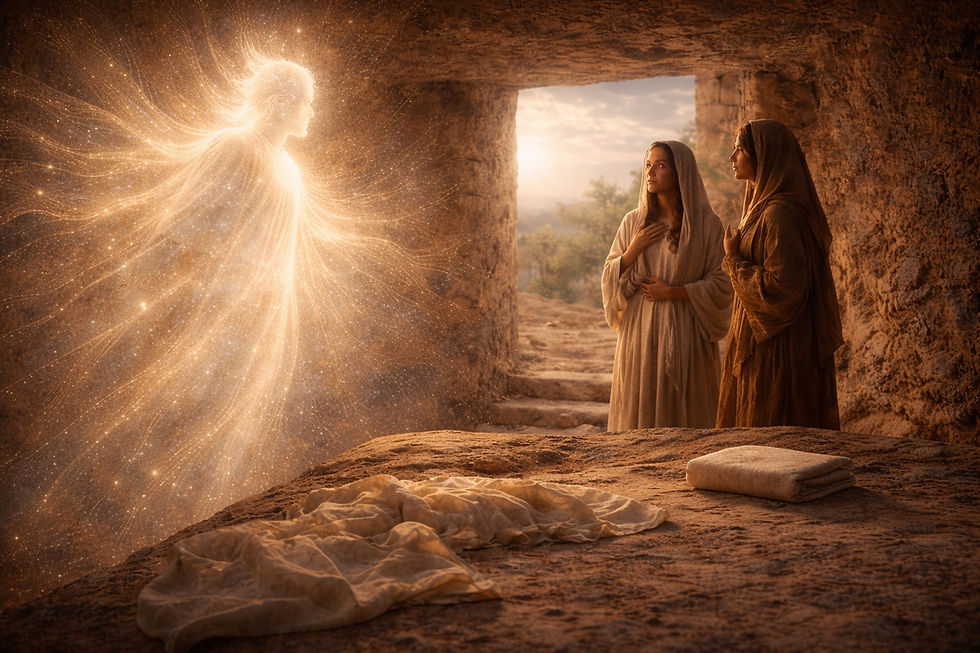
“But the angel said to the women, ‘Do not be afraid, for I know that you are looking for Yeshua who has been crucified. He is not here, for He has risen, just as He said. Come, see the place where He was lying. Then go quickly and tell His disciples that He has risen from the dead; and behold, He is going ahead of you into Galilee. There you will see Him; behold, I have told you.’”
— Matthew 28:5–7 (AMP)
⸻
The Verse That Opens Like a Door
There are some verses in Scripture that do not merely speak. They open. They feel almost simple when you first read them, and then all at once you realize you are standing in front of something so layered, so alive, so precise, that the more you look, the more it looks back at you.
This is one of those places.
At first, what stood out to me was that line:
“Just as He said.”
And I felt that catch in my spirit because resurrection did not happen randomly. It was not an emotional recovery plan stitched together after the horror of the cross. It was not heaven scrambling to make meaning out of tragedy. No. The angel says, in essence, This happened exactly the way He told you it would.
Which means resurrection is not only power.
It is integrity.
It is the proof that the Word of God can be trusted all the way through death, silence, confusion, delay, sealed stones, dark mornings, and human misunderstanding.
And then I noticed something else.
The angel gives three instructions in order.
Do not be afraid.
Come, see.
Go, tell.
And suddenly the whole passage begins to unfold not just as resurrection announcement, but as a pattern.
A holy rhythm.
A prophetic sequence.
A revelation of how heaven moves with us when we are standing at the edge of something that feels too overwhelming to process.
⸻
Do Not Be Afraid
The first thing heaven does is not explain.
It calms.
The first thing the angel says is not, Here is the theology of resurrection.
It is, Do not be afraid.
That matters.
Because fear locks the senses.
Fear narrows perception.
Fear makes us stare at the wrong thing for too long.
And these women had every natural reason to be afraid. They had watched Yeshua crucified. They had carried spices and sorrow. They had come to a tomb, not a throne. They were looking for the body of the One they loved, and instead they were met with the kind of scene that would make any human nervous system tremble. The stone had been moved. The atmosphere was charged. Heaven had touched earth in a way that altered the visible world. Of course there was fear.
And yet the angel says, Do not be afraid.
Not because there was nothing awe-filled happening.
But because fear would keep them from receiving what was happening.
This is still true for us now.
One of the first works of heaven in moments of revelation is to steady us enough that we can perceive. God does not always remove mystery before He removes fear. Sometimes He speaks peace first so that our hearts can remain open long enough to understand the mystery standing in front of us.
And that alone is a word for the modern reader.
Because we are so accustomed to fear being our first interpreter.
We fear what we cannot explain.
We fear what we did not expect.
We fear what does not fit our categories.
We fear what looks like disruption.
But resurrection begins with an instruction to let fear loosen its grip so witness can begin.
⸻
You Are Looking for Yeshua Who Was Crucified
This next line is so tender to me.
The angel says, “I know that you are looking for Yeshua who has been crucified.”
In other words, heaven sees what kind of search they are in.
They are not yet looking for the risen Christ.
They are looking for the crucified Yeshua.
They are searching through the lens of trauma.
They are seeking Him according to the last thing they saw.
And if we are honest, so often do we.
How many times do we approach God through the lens of our last pain, our last disappointment, our last understanding, our last sealed place? How often do we seek Him according to Friday when heaven is already standing in Sunday?
This is one of the things I love most about the Lord.
He does not shame the women for seeking Him according to the level of revelation they currently have.
He meets them there.
The angel names it plainly, but gently: I know who you are looking for.
There is such compassion in that.
Heaven knows the version of Yeshua we think we are searching for. Heaven knows when we are still looking for Him inside loss, inside burial, inside old categories, inside the last place we laid our hope down. And heaven is kind enough to meet us there without leaving us there.
Because then comes the turn.
⸻
He Is Not Here
This may be one of the most world-altering sentences ever spoken.
He is not here.
Absence, yes—but not the kind of absence grief expects.
Not loss.
Not disappearance.
Not defeat.
An emptied tomb is not the same thing as a vanished Lord.
And this is where even science gives us metaphors that can help the modern mind imagine what Scripture is showing us. Not to reduce mystery into mechanics, but to make the mystery more translatable. Sometimes people hear theological language and immediately feel distanced from it because it sounds too abstract or too church-shaped or too disconnected from how reality works. But the longer I live, the more I see that Scripture and science are not enemies glaring across a room. They are often describing the fingerprints of the same God in different vocabularies.
Physics tells us that matter and energy do not simply vanish into nothing. They change form. They move. They transform. The pattern persists, even when the mode changes. That does not explain resurrection. Resurrection is far greater than physics. But it gives us a small metaphor. The tomb is empty not because Yeshua ceased, but because He had entered a different order of life. Identity remained. Presence remained. Recognition remained. But the mode had changed.
This is why resurrection is not mere reversal.
It is not God pressing rewind.
It is not resuscitation.
It is transformation.
And that is why the angel’s words are so exact.
He does not merely say, You lost Him.
He says, He is not here.
Why?
Because the place where death expected to keep Him is no longer the place where He can be found.
And that, beloved, is one of the deepest revelations of the resurrection life for us too. There are places where we keep returning mentally, emotionally, spiritually—old tombs, old labels, old losses, old identities—trying to find life in the place where life no longer lives.
But resurrection changes location.
It moves the center.
It reorders the coordinates.
It says, You cannot keep searching for the living among the dead.
⸻
For He Has Risen, Just As He Said
There it is again.
Just as He said.
I cannot get away from that phrase because it is not only an announcement of outcome. It is a vindication of voice.
Everything in the Christian life comes back to whether He can be trusted.
Can He be trusted when the promise delays?
Can He be trusted when the night gets long?
Can He be trusted when the tomb is sealed?
Can He be trusted when every visible sign says otherwise?
Resurrection answers yes.
Not a sentimental yes.
A blood-bought, stone-rolled, history-splitting yes.
He rose just as He said.
And I think this matters so much because a great deal of spiritual fatigue comes from the places where we quietly wonder if God will really do what He said. Not because we are evil. Not because we do not love Him. But because we are human, and Saturdays are long, and sealed stones look convincing, and grief can make memory go blurry. The disciples had heard Him speak of rising. The women had heard Him speak of rising. But hearing prophecy before the cross and holding it steady after the cross are not the same thing.
And yet heaven remembers what we forget.
The angel does not say, He has risen, though no one could have known.
No.
He says, He has risen, just as He said.
Which means resurrection is also a call to remember.
To remember what the Lord has spoken.
To remember what seemed impossible.
To remember that His Word does not become less true because the middle got dark.
And maybe that is part of why this passage feels so alive on Resurrection Sunday. It is not merely telling us that Yeshua defeated death. It is telling us that the One who speaks is the One who fulfills.
⸻
Come, See the Place
Then the angel says something that I love so much because heaven does not ask for blind panic, and it does not ask for detached theory.
It says:
Come. See.
This is the language of witness.
Not run from it.
Not imagine from a distance.
Not build doctrine without encounter.
Come close enough to look.
There is something profoundly Hebraic in that rhythm. In Scripture, seeing is never merely visual. Seeing is participatory. It is perceptive. It is the kind of seeing that changes you because once you have truly seen, you are no longer innocent of what has been revealed.
The angel does not merely announce resurrection and send them away floating in abstraction.
He invites them into evidence.
Come and see the place.
Come and look at where death thought it had authority.
Come and stare at the vacancy.
Come and let your senses be reoriented.
Come and see that the place of burial has become the place of witness.
And again, this speaks so deeply to the modern reader because revelation is not anti-thought. It is not asking you to shut your eyes and pretend. It is inviting you to inspect the place where the old conclusion no longer holds. Resurrection faith is not irrational. It is supra-rational. It does not deny reality. It reveals a reality deeper than the one fear first interpreted.
Even the metaphors of science can help here. Sometimes in physics a reality is present before the observer fully understands what is being observed. The field changes, and then perception catches up. The system shifts, and then the instruments begin to register what has already become true. In a small and imperfect way, that helps the imagination here. Resurrection had already happened. The women were being invited to catch up to the reality that had already changed the world.
Come.
See.
Let your eyes learn what heaven has already done.
⸻
Then Go Quickly and Tell
And then comes the third movement.
Go quickly and tell.
This is so important because revelation is never meant to terminate in private astonishment.
It wants a witness.
It wants a carrier.
It wants feet, mouths, hearts, lives.
The angel does not say, Come, see, and stay there forever.
He says, Come, see, and then go.
Why?
Because resurrection is not a secret to be admired.
It is a reality that demands transmission.
And notice the urgency: quickly.
Because despair spreads fast.
Fear spreads fast.
Rumor spreads fast.
Hopelessness spreads fast.
And heaven knows that resurrection news must outrun despair.
So the women are made heralds.
Not because the culture would have naturally elevated their testimony.
Not because the world would have immediately applauded female witnesses.
But because heaven is not constrained by the broken ranking systems of men. The Lord loves to use those the world overlooks, and here again on Resurrection Sunday He entrusts the first carrying of this world-changing news to women whose love had kept them near enough to witness.
That is not accidental.
The kingdom is full of this kind of holy reversal.
The ones who came to minister to the dead are the first to announce the Living One.
The ones who came carrying spices leave carrying history’s greatest proclamation.
And this too is part of what makes resurrection so deeply personal. Once you have come and seen the place where He was, you cannot keep it to yourself. It changes how you speak. It changes what you carry into rooms. It changes how you respond to the sealed places in other people’s lives. It changes how you hold your own story.
Because now you are not merely someone surviving history.
You are a witness.
⸻
Behold, He Goes Before You
And then, one more jewel.
He goes before you.
Do you see how kind this is?
The angel does not only say, He was raised.
He says, He is already moving.
He goes before you into Galilee.
That means resurrection is not static.
It is not merely a completed event to look back at.
It is living movement.
The risen Lord is already ahead.
Already waiting.
Already in motion toward the very place He told them He would meet them.
That is still true.
One of the great comforts of resurrection life is not merely that Yeshua was raised once upon a time. It is that He goes before us now. Into Galilee. Into ordinary places. Into familiar places. Into places marked by former calling. Into our confusion. Into our work. Into our future. Into the places where our faith must be rebuilt not only in glory-moments, but in daily life.
And that changes everything.
Because if He goes before us, then the unknown is never truly unoccupied.
If He goes before us, then our future is not empty space.
If He goes before us, then even the places we dread are already touched by resurrection presence before we arrive.
⸻
How Scripture and Science Shake Hands Here
I love when the Lord allows the language of creation to become a bridge for modern understanding. Not because science explains away mystery, but because sometimes it gives metaphors sturdy enough to help us carry the weight of revelation without feeling like we have to leave our minds outside the sanctuary.
So let me say it plainly.
When I hear resurrection, I do not hear contradiction to the deepest patterns of creation. I hear fulfillment. The God who designed every law of existence is not threatened by the language of physics. He authored reality. His fingerprints are all over it. Scripture says He is omnipresent, omniscient, omnipotent. Physics searches for unified fields, underlying coherence, realities more connected than surface appearances suggest. Different vocabulary, yes. But often there is an echo. A hint. A shared trembling around the truth that reality is more deeply woven than it first appears.
That is why ideas like continuity, transformation, resonance, and field-shift can help the modern mind. Not as replacements for Scripture, but as parables that help us feel it. Resurrection tells us identity can remain while mode changes. It tells us presence can precede perception. It tells us reality can be altered before human senses fully register the alteration. It tells us witness functions like signal-carrying: one localized event changes the field, and those who encounter it become transmitters.
Again, this is not me trying to turn theology into a science lecture.
It is the opposite.
It is me saying the Lord is so woven into reality that even the metaphors of science can bow and serve revelation when rightly held.
And in the end, resurrection is not less than physical.
It is more.
Not less than real.
More real.
Not less than embodied.
More gloriously embodied than death ever imagined possible.
⸻
The Witness We Are Meant to Become
So what does this mean for us today?
It means Resurrection Sunday is not merely a date on the church calendar.
It is a way of being.
It is a rhythm.
A pattern.
A lived sequence that we are invited to embody again and again:
Do not be afraid.
Come and see.
Go and tell.
Do not let fear interpret the moment before heaven speaks.
Come close enough to inspect the places you thought were over.
See what God has already done where despair expected finality.
Then go and carry that witness into the lives of others.
This is how resurrection keeps moving through history.
Through witnesses.
Through ordinary people who came trembling, saw clearly, and then refused to keep silent.
And maybe that is the deeper revelation hidden in this passage.
The angel is not only instructing the women.
He is discipling us.
Teaching us how heaven handles human fear.
Teaching us how revelation becomes embodied.
Teaching us that witnessing is not passive.
Teaching us that once we have seen the empty place, we are now responsible for what we carry.
⸻
Final Thought — The Pattern of Resurrection
Matthew 28:5–7 is so much more than announcement.
It is pattern.
It is pastoral care.
It is prophetic commissioning.
It is heaven saying:
Let fear fall back.
Let your eyes adjust.
Let your feet move.
And perhaps that is why this passage feels so alive today.
Because we are still the people standing in front of tombs.
Still the people trying to interpret absence.
Still the people carrying spices for what we think is over.
Still the people needing heaven to say, Do not be afraid.
Still the people being invited to come close enough to see.
Still the people being sent to go and tell that the world is not what death said it was.
Because He is not here.
He has risen.
Just as He said.
Come, see the place.
Then go quickly and tell.
And if we live that rhythm—if we truly let it enter our bones—then we ourselves become part of the witness.
Not merely readers of resurrection.
Carriers of it.
———
I Hear the Spirit Say…
“Beloved, do not be afraid of the places where I have already gone ahead of you.
Do not let fear make an altar out of what I have already conquered. Do not stand outside the place of revelation and let trembling become your teacher when I have already sent heaven to speak peace over you.
I know you have been looking for Me in the form of what you last understood.
I know you have been searching for Me according to the last pain, the last burial, the last version of the story your heart could bear to hold.
I know you have gone back to old tombs in your mind, old griefs in your body, old conclusions in your thoughts, trying to find Me there in the exact form you left Me.
But hear Me:
I am not there the way I was before.
I have risen.
And because I have risen, you cannot keep searching for living things in dead places.
You cannot keep kneeling at the site of old losses as though the stone still has the final word.
You cannot keep making covenant with the language of Friday when heaven has already spoken Sunday over the matter.
Do not be afraid.
That is not a gentle suggestion.
It is the first mercy of heaven.
Fear will lock you outside the revelation if you let it.
Fear will keep your eyes fixed on the wound without ever seeing the wonder.
Fear will tell you the empty place means absence, when in truth it means movement.
Fear will make you interpret silence as abandonment, when often silence is the trembling edge of a new thing I have already begun.
So let Me steady you.
Let Me calm the part of you that wants to run before it has seen.
Let Me quiet the part of you that would rather explain everything away than stand inside holy astonishment.
Let Me retrain your senses.
Come.
Yes, come closer.
Do not stay at a distance from the places you call painful, sealed, confusing, or over. Do not let disappointment keep you from drawing near to where My power has already moved. There are places in your life you avoid because they remind you of burial. There are memories you tiptoe around, prayers you no longer touch, hopes you folded away because you assumed the story had ended there.
But I say to you: come and see the place.
Come close enough to look again.
Come near enough to let revelation reinterpret what grief misnamed.
Come into the places you thought could only testify of death and let Me show you how empty they are becoming of the authority they once held over you.
For some of you, the tomb you must revisit is a heartbreak you thought defined you.
For some of you, it is a failure that still whispers your name with shame attached to it.
For some of you, it is a betrayal, a diagnosis, a loss, a buried dream, a long silence, a prayer that seemed unanswered.
You keep saying, ‘That is where everything ended.’
And I keep saying, ‘Come and see the place.’
Because I am teaching you that the places where death spoke loudly do not remain under death’s rule when I have entered them.
And after you come, after you see, after you let your eyes adjust to what heaven has done, then go.
Do not keep resurrection only as a private comfort.
Do not hold revelation in silence as though it belongs to you alone.
What I show you is never meant to die inside you.
Go quickly and tell.
Tell with your words.
Tell with your choices.
Tell with the way you forgive.
Tell with the way you rise again after being broken.
Tell with the way you refuse to bow to finality.
Tell with the way you walk into rooms carrying peace where panic expected to reign.
Tell with the way you endure, the way you hope, the way you love, the way you remain soft in a world that taught you hardness was wisdom.
You think witness only means preaching, but I tell you witness is the whole shape of a life that has encountered My resurrection and can no longer speak the language of hopelessness with the same fluency.
And hear this too:
I go before you.
I am not waiting behind you in the place of your last sorrow.
I am not trapped in the tomb where you laid down your expectation.
I am not stranded in the chapter that wounded you.
I go before you.
Into Galilee.
Into the ordinary.
Into the familiar.
Into the very places where life must now be lived.
Into your future, your calling, your relationships, your work, your healing, your unanswered questions, your next breath, your next yes, your next act of obedience.
I go before you.
That means there is no tomorrow you will enter alone.
There is no unknown terrain where I am absent.
There is no place you fear that I have not already touched with My presence.
Beloved, resurrection is not only an event to celebrate.
It is a pattern to live.
Do not be afraid.
Come and see.
Go and tell.
Let fear fall back.
Let revelation come near.
Let testimony move through you.
And when you are tempted to return again to the place where death once convinced you it had won, remember what heaven said at the tomb:
He is not here.
I am no longer contained by the place where you thought the story ended.
And neither are you, if you belong to Me.
So rise in your thinking.
Rise in your expectation.
Rise in your courage.
Rise in your witness.
For I did not bring you this far to leave you interpreting empty places as loss.
I brought you here so you could see that what once held death now testifies of life.
And if you will come close enough, I will teach your heart to read the signs of resurrection everywhere.”


Comments